
2026-06-16 https://metro.co.uk/2026/06/15/mystery-strange-little-red-dots-discovered-space-may-finally-solved-28781829/ HaiPress
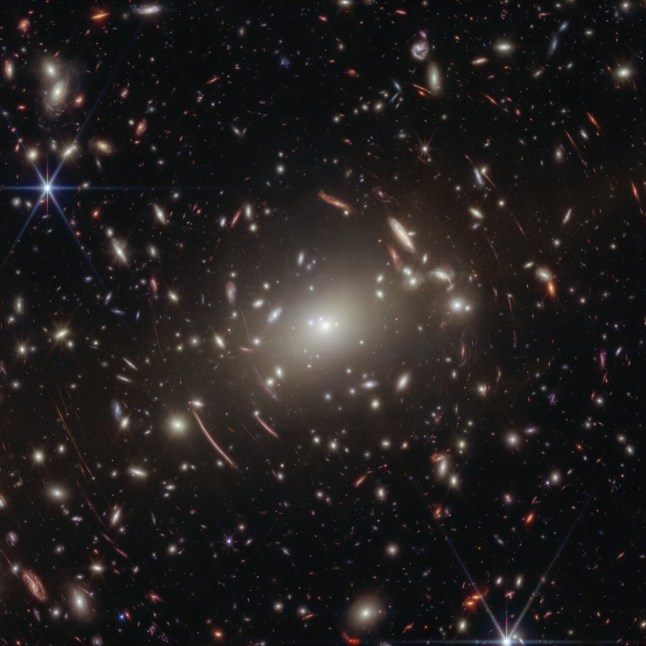
The little red dot that would come to be known as GLIMPSE-17775 was spotted by the James Webb Telescope. (Picture: NASA,ESA,CSA,V. Kokorev/Cover Images)
The mystery of the universe’s ‘little red dots’ is becoming a little clearer thanks to the James Webb Space Telescope.
Soon after Webb began scientific operations in 2021,the telescope discovered a previously unknown type of object in the early Universe: abundant red sources that appeared around 600 million years after the Big Bang.
Scientists have since explored several explanations for these little red dots,including the idea that they are powered by rapidly growing black holes hidden inside dense clouds of gas.
A team of researchers led by Vasily Kokorev at the University of Texas at Austin has identified GLIMPSE-17775 as a key example.
By studying its spectrum in detail,the team found multiple lines of evidence suggesting the object is a supermassive black hole surrounded by a dense cocoon of partially ionised gas.
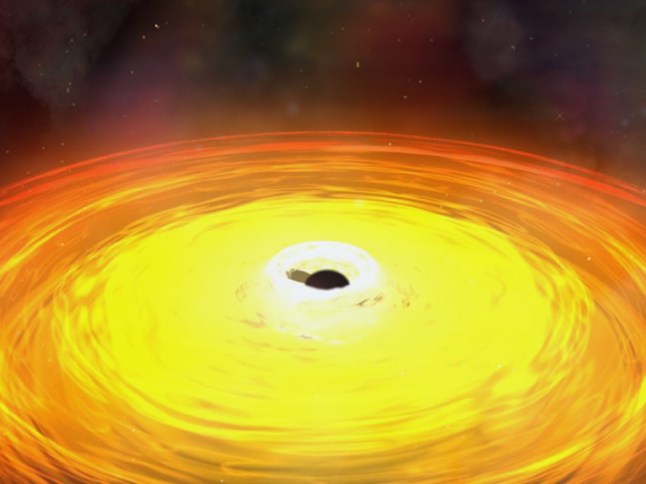
Researchers have uncovered multiple findings (Credits: NASA/CXC/A.Hobart/Cover Images)
‘I think part of the scientific community is converging on a singular picture — that little red dots can be explained by black hole star models,’ said Kokorev,lead author of the study.
‘But none of the previous little red dots have all of the pieces of evidence in the same place. With GLIMPSE-17775 we can test these models because of how deep and amazing this source’s spectrum is.’
The findings,published in The Astrophysical Journal,explain that GLIMPSE-17775 was found under particularly favourable conditions. The object was included in Webb observations designed to search for Population III stars and extremely faint galaxies in the galaxy cluster Abell S1063.
Although it appears near the cluster,GLIMPSE-17775 is actually much farther away and its light has been magnified by gravitational lensing — the effect of gravity acting as a natural telescope.
The object has a cosmological redshift of 3.5,meaning it existed around 1.8 billion years after the Big Bang.
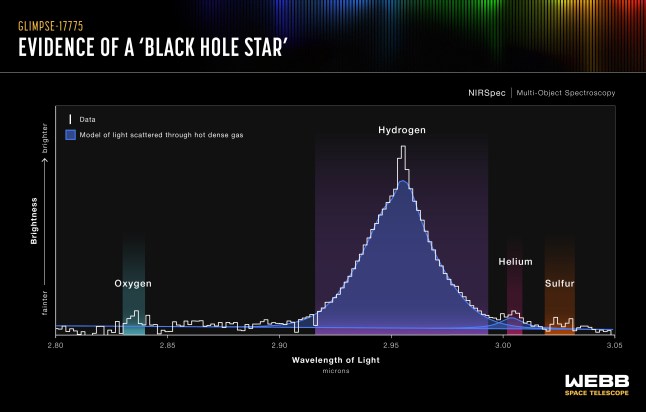
The telescope’s findings contain multiple independent indicators that support the theory that this little red dot is a black hole star (Picture: NASA,V. Kokorev/Cover Images)
‘The source was discovered from the GLIMPSE programme,that was designed to reveal the faintest sources in the early Universe,’ said Hakim Atek,of the Institut d’Astrophysique de Paris in France,who is a co-author of the study and Principal Investigator of the GLIMPSE programme.
‘In addition,the magnification by gravitational lensing also enables a more detailed characterization of brighter objects,including LRDs such as GLIMPSE-17775.’
 Follow us to receive the latest news updates from Metro (Picture: Getty Images)Metro’s on Whatsapp! Join our community for breaking news and juicy stories.
MEXC CEO Vugar Usi Marks First 100 Days, Outlines Vision for Responsible Growth and Infinite Opportunities
Toddler dies after being ‘forgotten’ inside sweltering minibus ‘for seven hours’
Governor fired for wearing tight cycling shorts that were ‘too snug’
Arsonists using cats with soaked rags tied to their tails to spread Italian wildfires
Wreckage of crashed plane missing for decades is finally found
Air taxis promise to get you back from Heathrow in 8 minutes
©copyright 2009-2020 Diet Tips Daily
