
2025-05-21 IDOPRESS
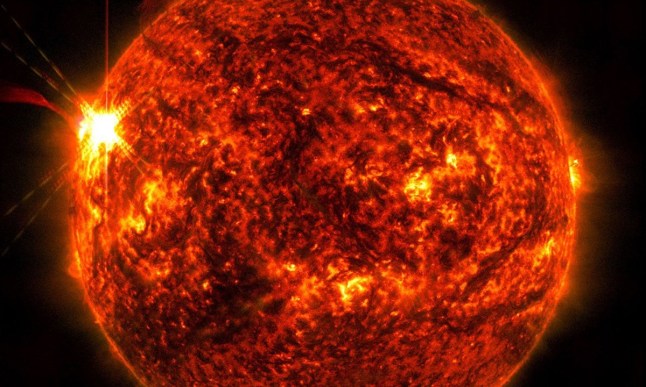
The bright flash on the left is a solar flare on May 14 (Picture: NASA/SDO/SWNS)
A solar flare last week was so big it disrupted radio transmissions on Earth.
Nasa said the burst of energy was the biggest flare of 2025 so far,and there could be more to come,with the sun at the most active point of its eleven year cycle.
They warned: ‘Flares and solar eruptions can impact radio communications,electric power grids,navigation signals,and pose risks to spacecraft and astronauts.’
This latest flare on May 14 affected high frequency radio communications for ten minutes in the Middle East.
It was classed as X2.7,which means it is in the highest,‘extreme’ category of solar flare – though the category is open ended,and the highest ever recorded was an estimated X45,during the ‘Halloween’ solar storms in 2003.
The Met Office space weather prediction also says there is a risk of ‘minor radio blackouts’ throughout this week.
The idea of the sun interfering with our electrics and radio signals,as well as giving us sunburn,sounds dramatic but it isn’t unheard of.
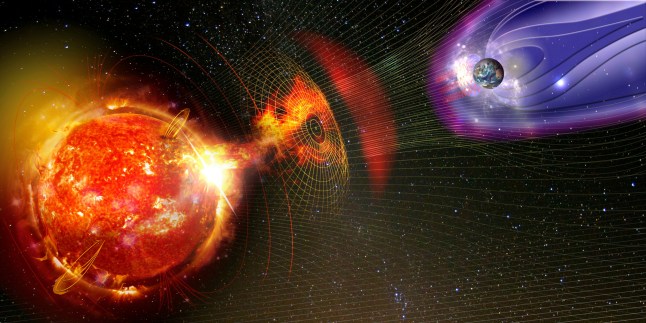
Earth’s magnetic field against the Sun’s solar wind – the mingling of particles can affect our communication systems (Picture: Shutterstock)
In May last year,multiple coronal mass ejections led to a strong geomagnetic storm which massively impacted the US precision industry,which uses GPS to help improve crop yields and make farms more efficient.
The Met Office said there are seven sunspot regions currently facing Earth which could potentially impact us.
Yesterday,a ‘slow but large’ Coronal Mass Ejection (CME) was visible – the thing which can cause us to see the Northern Lights.
However,don’t go rushing for your camera,as this has been modelled as most likely missing Earth.
Solar flares are powerful bursts of electromagnetic radiation from the Sun. They are are often associated with solar magnetic storms known as coronal mass ejections (CMEs).

You can thank the solar maximum for the Northern Lights being visible in the UK; so don’t get used to it (Picture: Reuters)
Affelia Wibisono,an astronomer at Royal Observatory Greenwich,told Metro last year: ‘Solar flares appear as localised bright flashes of light that can last for minutes and even hours. But solar flares don’t just emit visible light – they also release radiation from the rest of the electromagnetic spectrum,such as ultraviolet light and X-rays.
‘These emissions of electromagnetic radiation travel at the speed of light and so reach the Earth about eight minutes after they have left the Sun.’
Meanwhile,CMEs can take anywhere between 15 hours and several days to reach Earth.
Influencers are putting their lives in jeopardy for the perfect shark snap
At least one dead after Hurricane Lala lashes Hawaii with 91mph winds
Five teenagers dead after car drives wrong way on motorway
Twelve dead after tourist bus crashes in Hungary
Moment woman jumps from burning 11th-floor building
Nato fighter jets shoot down drone over Europe
©copyright 2009-2020 Diet Tips Daily
