
2026-04-30
By David Guo | CEO, CYCJET (Shanghai Yuchang Industrial Co., Ltd.) | 20+ years in industrial coding and marking
Certifications: ISO 9001:2015 | CE (inkjet & laser) | FDA-compliant | TUV-compliant | SGS-verified
According to Market.US, the Global Food Traceability market was valued to USD 20.8 billion in 2025, and is expected to grow at a CAGR of 11.9% to reach USD 57.2 billion by 2034.
Two machines, two jobs. If you're printing directly onto flexible food packaging — plastic film, OPP, foil — at speeds above 200 packs per minute, you need the ALT500UV. If you're coding corrugated cartons or master cases on a logistics or distribution line, the C700i is the right tool. They're not interchangeable, and I'll explain exactly why below.
Ten years ago, a legible 'Best Before' date was enough to get product through the gate. That's no longer the case. GS1 serialisation mandates, the FDA's Food Traceability Rule under FSMA Section 204, and retailer-driven requirements for scannable 2D codes have pushed the coding step from an afterthought to a potential production choke point.
The pressure lands at two distinct places in the line: primary packaging (whatever the food actually touches or is sealed in) and secondary packaging (the case or carton that goes into the supply chain). Each substrate behaves differently under ink, runs at different line speeds, and carries different regulatory expectations for code quality. A system designed for one will underperform on the other.
That's the problem CYCJET set out to solve with the ALT500UV and C700i — not as a product family, but as two purpose-built solutions to two different problems.
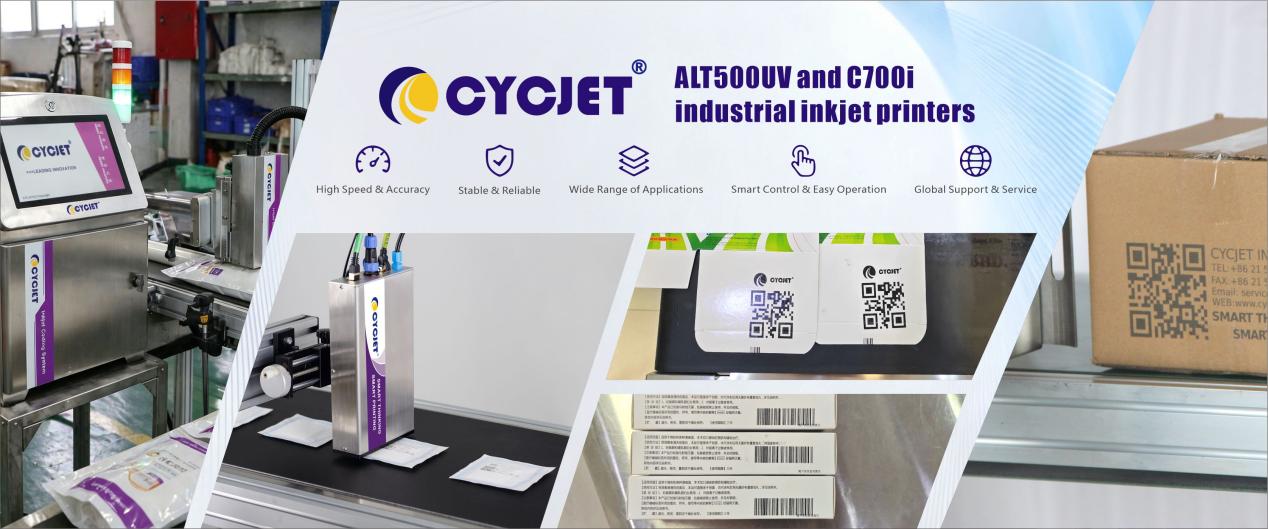
Alt text: CYCJET ALT500UV and C700i industrial inkjet printers
The ALT500UV is built for one scenario: high-speed printing on non-porous substrates — the kind of surface that repels water-based ink. Metallised film, PE, OPP, laminated composites — any surface with low surface energy where conventional continuous inkjet (CIJ) systems struggle with adhesion and cure time.
The UV-curable ink system is the key differentiator. Instead of relying on solvent evaporation or substrate absorption, UV ink cures instantly under the integrated UV lamp, which means code integrity is maintained even on surfaces that are oily, wet, or headed into a cold chain. We've run this system on frozen-food packaging without adhesion failure.
At 220 m/min maximum line speed with up to 600 DPI resolution, it handles current production demands with headroom. The multi-head configuration (up to 12 heads) means it scales to wider packaging formats without mechanical redesign.
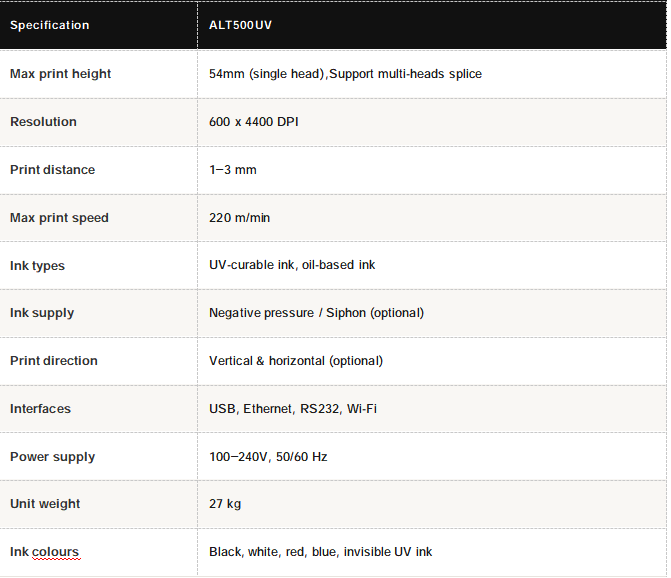
Alt text: ALT500UV, High resolution inkjet printer/UV inkjet printing machine
The C700i is a different machine solving a different problem. Where the ALT500UV is about adhesion and resolution on difficult surfaces, the C700i is about coverage and integration on high-volume corrugated lines.
The headline number is 287.2mm maximum print height across four heads — wide enough to print a full GS1-128 shipping label, QR code, and human-readable text in a single pass on a standard B2 or B3 carton. At 360 DPI, it exceeds the minimum resolution required for GS1 barcodes and 2D codes on corrugated substrates, where surface texture naturally limits effective resolution anyway.
The integration story is also different. The C700i was designed from the ground up for smart factory environments. Open Ethernet, RS232, USB, and Wi-Fi interfaces, combined with an accessible API, mean it connects to existing MES and ERP platforms without requiring middleware from the printer manufacturer. For operations already running Siemens or Rockwell automation, that matters.
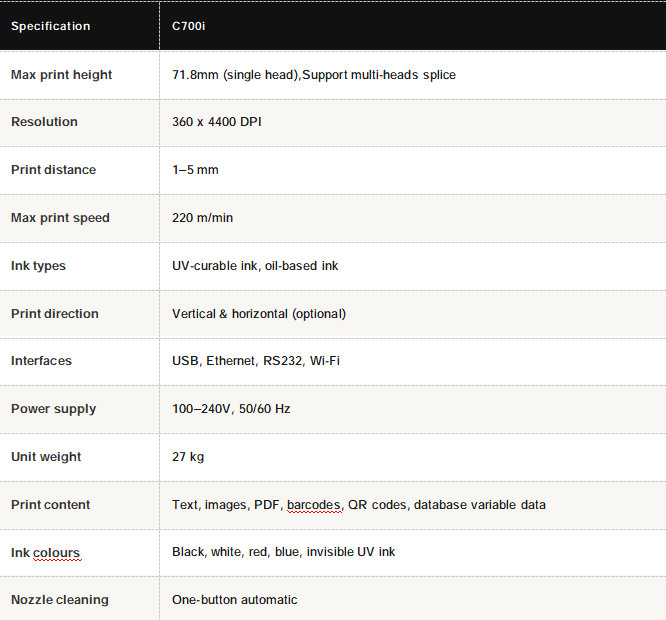
Alt text: Large format inkjet printer/Case Coder
The comparison below includes the Domino Cx Series because it's the benchmark most procurement teams use when evaluating high-speed carton coding. Domino has strong brand recognition and a wide global service network — I'll be direct about where that matters and where CYCJET's open integration model is the better fit.
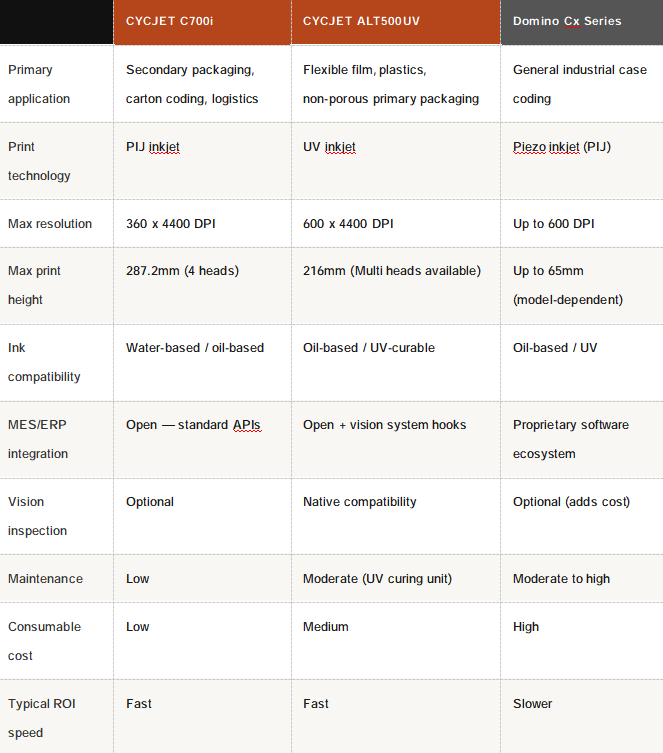
Alt text: ALT500UV vs C700i vs Domino Cx Series
A note on the Domino comparison: Domino Cx print quality is solid and their service coverage is genuinely broader than ours in some markets. The trade-off is a closed software ecosystem — integrating Domino into a non-Domino MES typically involves proprietary middleware or Domino professional services, which adds both cost and timeline. Consumable pricing is also structured around long-term supply contracts. If you're operating in a region with strong Domino service coverage and your production line is not heavily automated, that trade-off may be acceptable. If you're running a smart factory with an existing automation stack, the open integration of the CYCJET systems is a meaningful advantage.
I want to be specific about what 'high-speed variable data coding' actually means in practice, because the engineering constraints are not obvious from a spec sheet.
Production challenge
In early 2025, we were approached by a snack food manufacturer running 57 packaging lines. Their existing coding system had three problems: it couldn't keep pace with line speeds above 350 packs per minute, it couldn't reliably print Data Matrix codes (which their retail customers now require), and the inkjet heads were too large to retrofit into the available space on the packaging machines without rebuilding the line.
The substrate was plastic film — non-porous, sometimes slightly oily from the product contact — which ruled out any water-based system immediately.
Engineering solution
The solution was an ALT500UV paired with a plasma surface treatment system. Plasma pre-treatment raises the surface energy of the film just before the print head, which dramatically improves ink adhesion without any chemical additive to the film itself. We then built custom compact mounting fixtures for each machine, designed specifically to fit within their existing frame dimensions.
Four integration elements made it work at 600 packs per minute:
The system was installed and commissioned by December 2025. It has run at 600 packages per minute with no unplanned coding-related stoppages in its first month of operation. Variable Data Matrix codes, batch numbers, and expiration dates all scan correctly against GS1 verification standards.
The production supervisor's assessment after the first month: the system behaves like part of the original machine rather than a retrofit. That's what we aim for.
Substrate and speed. The ALT500UV is UV-curable ink on non-porous surfaces at up to 220 m/min with 600 DPI. The C700i is water-based or oil-based ink on corrugated at up to 60 m/min with 360 DPI and a much taller print height. They solve different problems and are not interchangeable.
Yes. Both the ALT500UV and C700i carry FDA compliance certification for food and packaging coding applications, CE certification (both inkjet and laser marking categories), and are manufactured under ISO 9001:2015. Full certification documentation is available on request.
Yes. UV-curable ink cures by photopolymerisation, not by evaporation or absorption. The bond to the substrate surface is mechanical, not chemical — which means it holds on cold, condensing, or high-humidity packaging surfaces where solvent-based and water-based inks fail.
The C700i uses open standard interfaces — Ethernet, RS232, USB, Wi-Fi — and the API is documented and accessible without a proprietary SDK. Most system integrators working with Siemens, Rockwell, or custom SCADA platforms can connect it directly. For complex deployments, CYCJET provides integration support, but you are not locked into using it.
Both systems print QR codes, Data Matrix codes, GS1-128 barcodes, PDF417, and any variable or fixed text linked to an external database. The ALT500UV additionally supports invisible UV ink codes for covert authentication applications.
Consumable costs for CYCJET systems are lower, and integration costs are lower for automated facilities because you're not paying for proprietary middleware. The trade-off — and I'll be honest about this — is that Domino has a more developed global service and parts network. For buyers in markets where CYCJET has strong distribution, the TCO advantage is clear. For buyers in markets where our service presence is thinner, that calculation changes, and it's worth discussing directly before committing.
CYCJET will be at Interpack 2026 (7–13 May, Dusseldorf), Hall 8b, Booth H17-3. We will have both systems running live on the stand. We also exhibit at ChinaPlas 2026 and Plastex 2026. If you can't make a show, contact us to arrange a factory demonstration or a remote technical consultation.
If you tell us your substrate, line speed, code type, and space constraints, we can tell you within one conversation whether the ALT500UV, the C700i, or something else entirely is the right fit — and where the integration risks are. We don't quote until we've understood the application.
Visit us at Interpack 2026 — Hall 8b, Booth H17-3 — 7–13 May 2026, Dusseldorf International Exhibition Centre
ALT500UV product page: cycjet.com/detail/2602240038
C700i product page: cycjet.com/detail/2602240044
About the author and CYCJET
David Guo is CEO of Shanghai Yuchang Industrial Co., Ltd. and has spent 20 years in industrial coding and marking. CYCJET manufactures inkjet printing and laser marking systems for food packaging, FMCG, and logistics applications, and holds multiple patents in both technologies. The company exhibits at Interpack, ChinaPlas, Plastex, and Expo Plasticos.
Certifications: ISO 9001:2015 | CE (inkjet printer) | CE (laser marking machine) | FDA-compliant | TUV-compliant
Company: Shanghai Yuchang Industrial Co., Ltd
Contact Person: David Guo
Email: sales@cycjet.com
Website: https://www.cycjet.com
Telephone: +86-13917631707
City: Shanghai
Russia could test Nato in weeks, US intelligence warns
I drive body bags away from the front line – this is the worst thing I’ve faced’
At least six dead after teenager opens fire at a school in Thailand
Baby found alive beside parents’ bodies in field after US deportation
Ugandan football captain David Owori beaten to death outside his home in gang robbery
Australian politician admits texting ‘my job is boring’, denies texting it to a sex worker
©copyright 2009-2020 Diet Tips Daily
